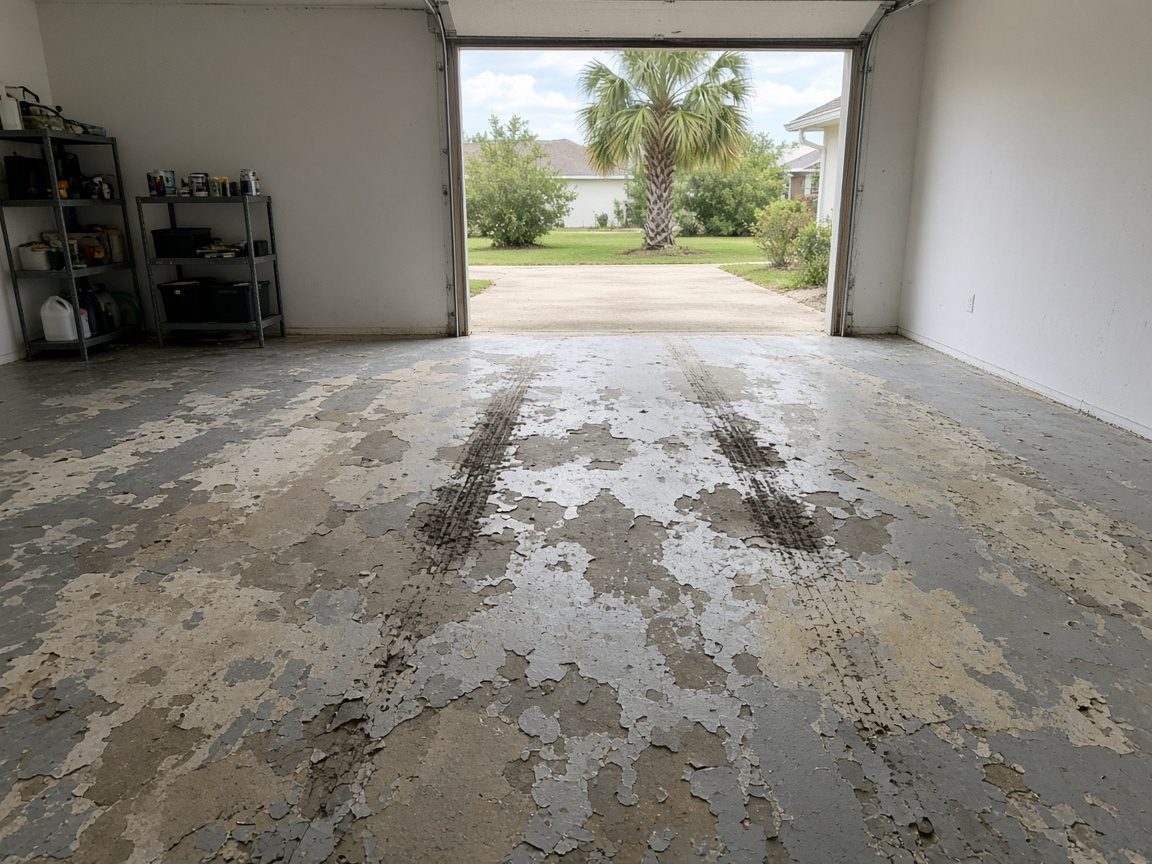
Before
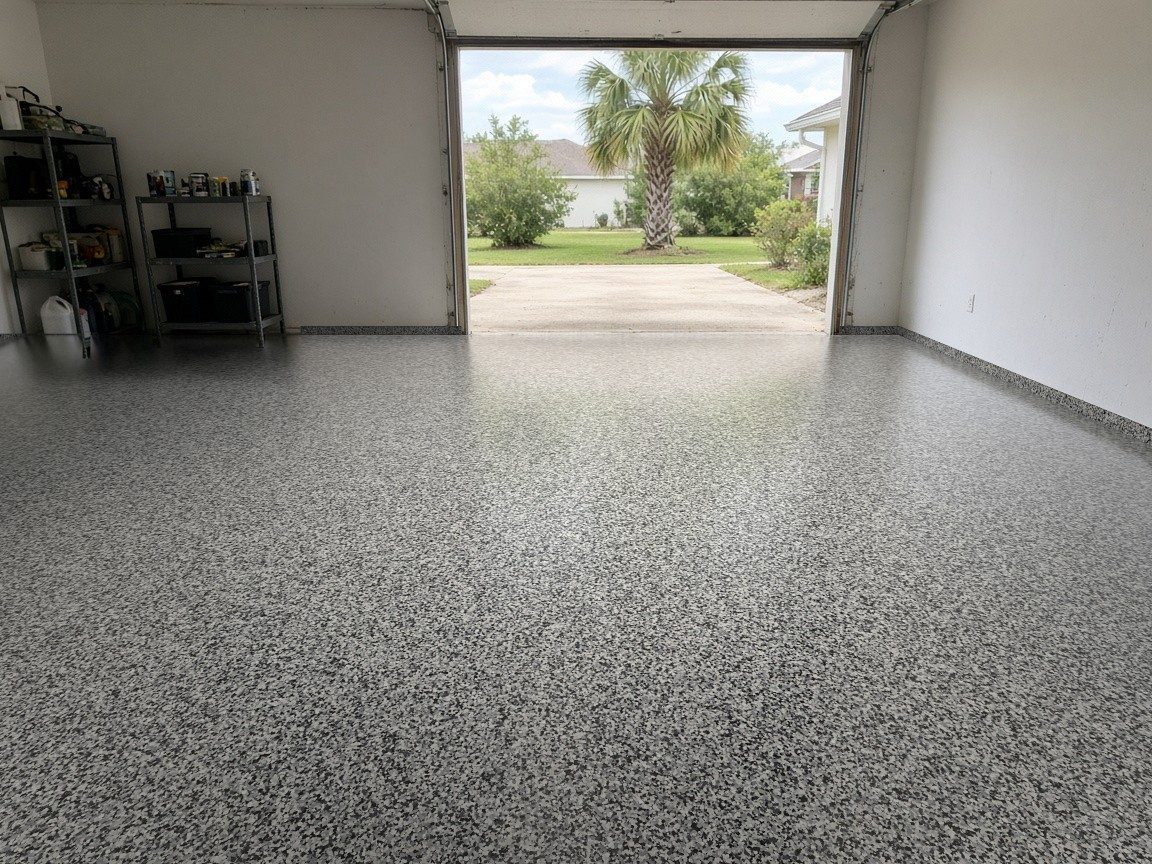
After
If you’ve started shopping for a garage floor, you’ve already run into the words epoxy, polyurea and polyaspartic. Every company says theirs is best. Here’s a plain-English breakdown of what each one is, where it shines, and why we build our flake floors the way we do.
Quick Answer
For a Jacksonville garage, the best value is a layered system: a strong base coat bonded into diamond-ground concrete, a full flake broadcast, and a polyaspartic topcoat on top. Plain epoxy by itself, as the final layer, is the weak link in Florida because of sun and heat.
What Is Epoxy?
Epoxy is a two-part resin and hardener that cures into a thick, hard film. It’s been used on floors for decades.
Where it’s good: It bonds well to properly prepared concrete, builds thickness well, and costs less per gallon than polyaspartic. That makes it a solid base coat.
Where it struggles: – UV. Epoxy yellows, or ambers, in sunlight. Near an open garage door it shows. – Cure time. Epoxy cures slowly, especially in humid weather, so you’re often waiting several days to park. – Hot tires. Softer epoxies, and especially thin water-based DIY kits, are the coatings most associated with hot tire pickup.
What Is Polyurea?
Polyurea is a fast-curing, flexible coating. Used as a base coat, it bonds into the concrete and can handle a little movement as the slab heats and cools. It cures fast, which helps make a quick install possible. The tradeoff is a short working time, so it takes an experienced crew to install it right. Some installers use polyurea as the base coat. Our standard system uses polyaspartic for both the base coat and the clear topcoat.
What Is Polyaspartic?
Polyaspartic is a type of aliphatic polyurea, and it’s what we use as the clear topcoat on every floor.
- UV stable. It won’t yellow in the sun.
- Hard and abrasion resistant. It stands up to tires, foot traffic and dragged items better than a soft finish.
- Chemical resistant. Oil, gas, brake fluid and household cleaners wipe up.
- Fast cure. You can usually walk on it the same day and drive on it in about a day.
- Works in a wider range of temperature and humidity than many epoxies.
The downside is cost. Polyaspartic resin is more expensive, which is why most quality systems use it where it matters most: on top.
Side-by-Side Comparison
| Plain epoxy (topcoat) | Polyaspartic (topcoat) | |
|---|---|---|
| UV / yellowing | Yellows in sun | UV stable |
| Cure time | Days | Hours |
| Hot tire resistance | Weaker | Stronger |
| Chemical resistance | Good | Very good |
| Material cost | Lower | Higher |
| Best use | Base coat, indoor floors | Topcoat, garages, outdoor floors |
The System We Use
Here’s the system we typically install:
- Diamond-ground concrete so the coating bonds into the slab
- polyaspartic base coat
- Full vinyl flake broadcast, wall to wall
- Clear polyaspartic topcoat
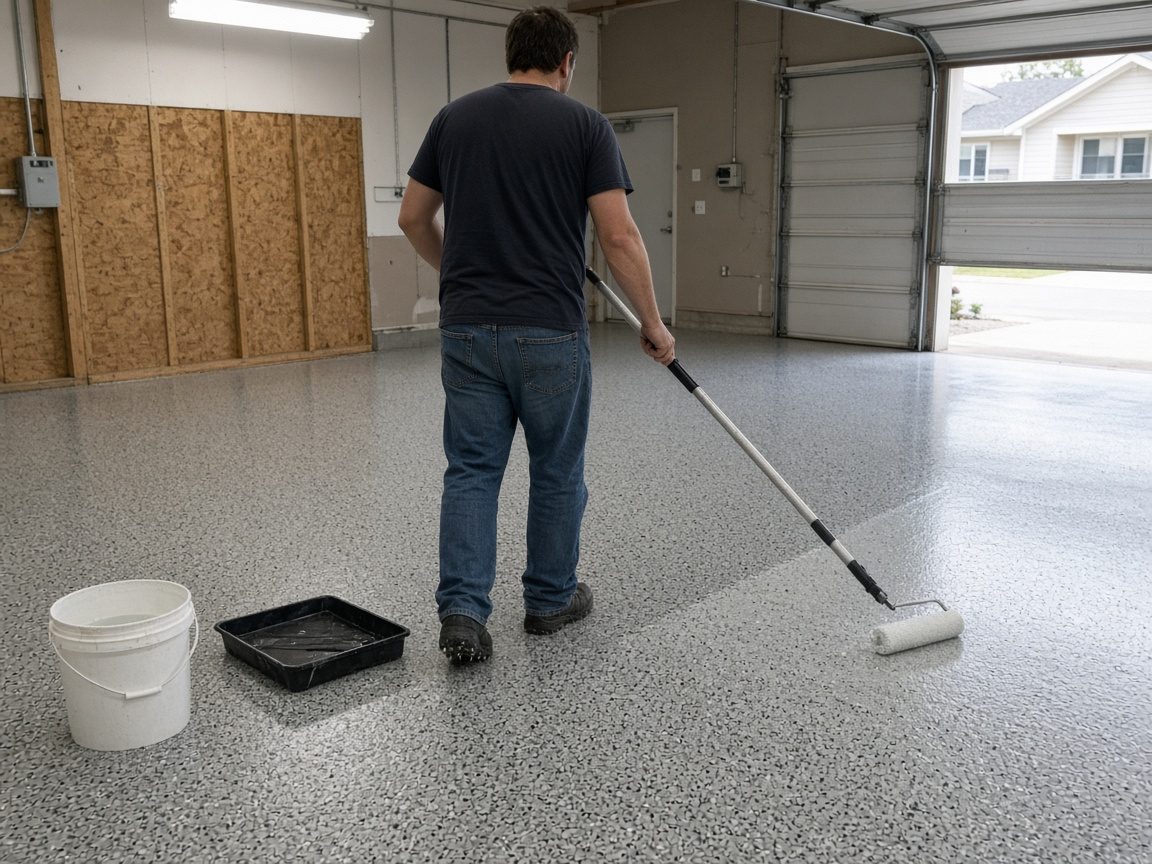
That combination is what handles Florida heat, sun, hot tires and humidity. See it step by step on our flake floor process page, or read about garage floor coating.
Prep Matters More Than Chemistry
The honest truth: the best coating in the world will fail on a badly prepared slab. Most peeling floors we see weren’t ruined by the wrong product. They were rolled onto concrete that was never ground, or onto a slab with moisture coming up through it. That’s why every floor we do starts with diamond grinding and a slab check, no matter which materials go on top.
What About DIY Epoxy Kits?
Kits are cheap for a reason. Most are thin, water-based epoxy over acid-etched concrete, with a light sprinkle of flake. They can look fine for a while, but they’re the floors that peel under hot tires in a Florida summer. If you’ve got a failing kit floor now, we grind it off and start fresh.
Frequently Asked Questions
Is polyaspartic better than epoxy?
As a topcoat in Florida, yes. Polyaspartic is UV stable, cures faster and holds up better to hot tires. Epoxy is still a good, affordable base coat when it is protected by a polyaspartic topcoat.
Why does epoxy turn yellow?
Most epoxies are not UV stable. Sunlight breaks down the surface and gives it an amber color. That’s why we always finish with a UV-stable polyaspartic topcoat.
What causes hot tire pickup?
A hot tire softens and grips the coating as it cools, and if the coating isn’t bonded well to the concrete, it pulls up. Diamond grinding and a hard polyaspartic topcoat are the fix.
Is polyaspartic more expensive?
Per gallon, yes. Using it as the topcoat over a strong base coat keeps the cost reasonable while giving you the benefits on the surface that takes the wear.
Can you coat over my old epoxy floor?
Usually the old coating has to be ground off first so the new system bonds to the concrete. We’ll look at it at the estimate.
Get a Free Estimate
Call 904-444-9190 (Monday to Friday, 8:30 AM to 5 PM) or fill out our free estimate form. Want a ballpark first? See our garage floor coating cost guide.
Licensed and insured, in business since 2019, with nearly 200 Google reviews.